Ask your consolidated ledger a question

Consolidation tells you what the numbers are. The harder question is what they mean, and across a group of entities that is slow, manual work. These features answer from your own ledger — and show their working, because a figure you cannot trace is not much use in a board pack.

app.reporting.apbuddy.io/app/board-brief
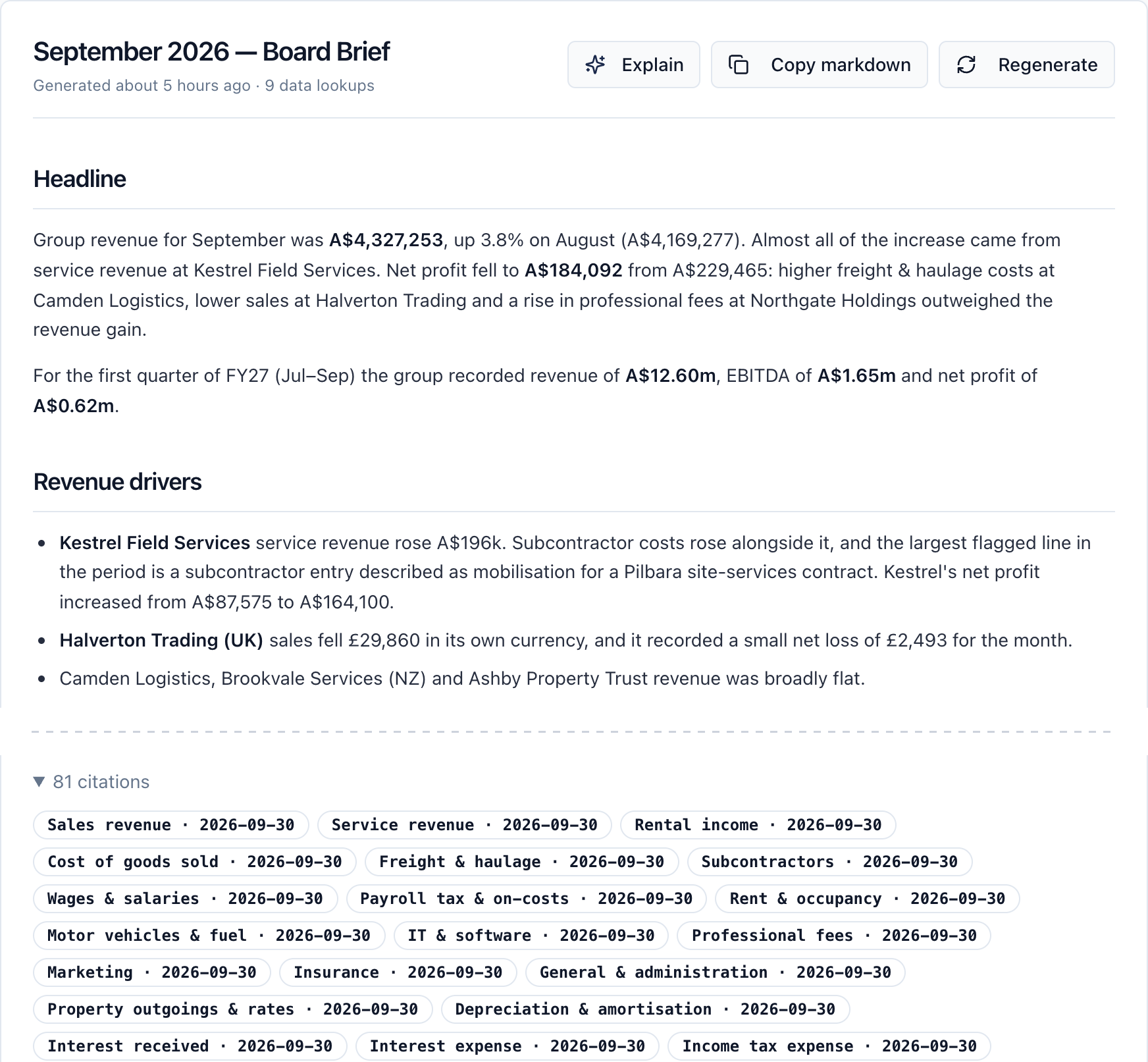
A saved monthly board brief for September with a headline, revenue drivers and margin commentary, and its list of citations beneath.
  1. 1 Written from the consolidated figures for the period, in the voice of a finance partner.
  2. 2 Saved with its citations: the accounts and periods each figure came from.

The real app, showing a sample group. Figures, entity names and the brief’s text are invented: it was written for this capture, not generated.

Ask the CFO

A question in plain English, answered from your own ledger.

Reads
Group and per-entity statements, period comparisons, entity rankings, cash, close-control findings
Every figure
Pulled by a query, not estimated
Writes
Nothing to your Xero ledger

“Which entities drove the drop in gross margin last quarter?” The model does not receive your accounts as a block of text to summarise. It queries them, and can go back for more before it answers.

The distinction matters more than it sounds. A model handed a summary can only reason about what the summary happened to include. A model holding query tools can go and look — which is why it can answer a question nobody anticipated when the report was designed.

Board Brief

A monthly board pack, written from the consolidated numbers.

Covers
Any period you pick
Sections
Headline, drivers, per-entity movement, exceptions
Saved with
Its citations: the periods, entities and accounts behind each figure

Written in the voice of a senior finance partner, with the citations listed beneath the text so a reader can check any figure without leaving the page.

The citation list is the point. A generated narrative you cannot trace is a liability in a board pack, because the first question in the room is “where did that number come from?” and “the AI wrote it” is not an answer.

Entity month-end memo

The same treatment, one entity at a time, saved as a pack.

Written from
One entity's statements and its prior-period comparatives
Saved with
A snapshot of the figures it was written from

Because the snapshot is stored with the memo, reopening a saved pack months later replays the numbers as they stood, not as they are now.

Without the snapshot, a saved commentary silently decouples from its data — the prose says one thing, a re-query says another, and nobody can tell which was right at the time. Storing both together is what makes a memo re-readable in February.

Weekly digest

What changed, and what needs looking at, without opening the app.

Window
The last seven days of anomaly notifications
Includes
Group snapshot against the prior month, posting-lag headline, findings by type with count and exposure
Delivered
In the app; by email too when email delivery is configured

Findings are grouped by type — close lag, duplicates, missed accruals, outliers — and the largest individual finding is named, so the one thing worth opening the app for is in the message itself.

Most exception reporting fails because it requires someone to remember to go and look. A digest that arrives on its own reverses the default: silence becomes a signal rather than an absence of one.
How the grounding works

Every one of these features runs through the same loop, so they answer from the same data and behave the same way when that data is imperfect.

  1. 1

    The question becomes tool calls

    The model chooses which slices it needs — a period comparison, a per-entity ranking, a journal filter — rather than being handed a fixed extract.

  2. 2

    Tools query the consolidated cache

    Each returns both the data and citations: the periods, entities and accounts the figures came from.

  3. 3

    It iterates

    It can go back for more, so a follow-up question the first result raises is answered before it replies.

  4. 4

    The answer carries its sources

    Citations are saved with the output, not discarded once the text is written.

Questions CFOs ask

Can AI write a board report from my accounts? +

Yes, and the mechanism matters. Board briefs here are generated by a model that queries your consolidated ledger through structured tools rather than being handed a summary to paraphrase. Each brief is saved with citations recording the periods, entities and accounts behind its figures, so any number in the narrative can be traced back to the data it came from.

How do you stop an AI inventing numbers? +

By never giving it the opportunity to guess. The system prompt requires that every numeric claim be grounded in data pulled by a tool call, and instructs the model to say what it lacks rather than estimate. It has no ability to write to your ledger and no source of figures other than the tools, so an invented number would have to survive a citation list that points at nothing.

Does it use my data to train a model? +

No. Queries run against the Anthropic API and your data is not used for training. Nothing is written back to Xero either — the entire product reads through the Xero API and writes nothing to your ledger.

What can it not do? +

It reads a monthly cache of your accounts, so it answers at period granularity rather than intraday. Duplicate matches are candidates for human review and are never presented as certainties. Cash classification uses a name heuristic over your chart of accounts, which an administrator can override where it misses. Where an FX rate is missing, the model is instructed to say the figure may understate rather than present it as complete.

Is this financial advice? +

No. It is analysis of your own figures, written for a finance professional to read and judge. It surfaces what moved, what looks unusual and what appears to be missing. Deciding what any of that means for the business is the CFO's job, and the output is written on that assumption.

See it answer on your own numbers

The quickest way to judge this is to ask it something you already know the answer to, and see whether it agrees with you.

Book a call →